
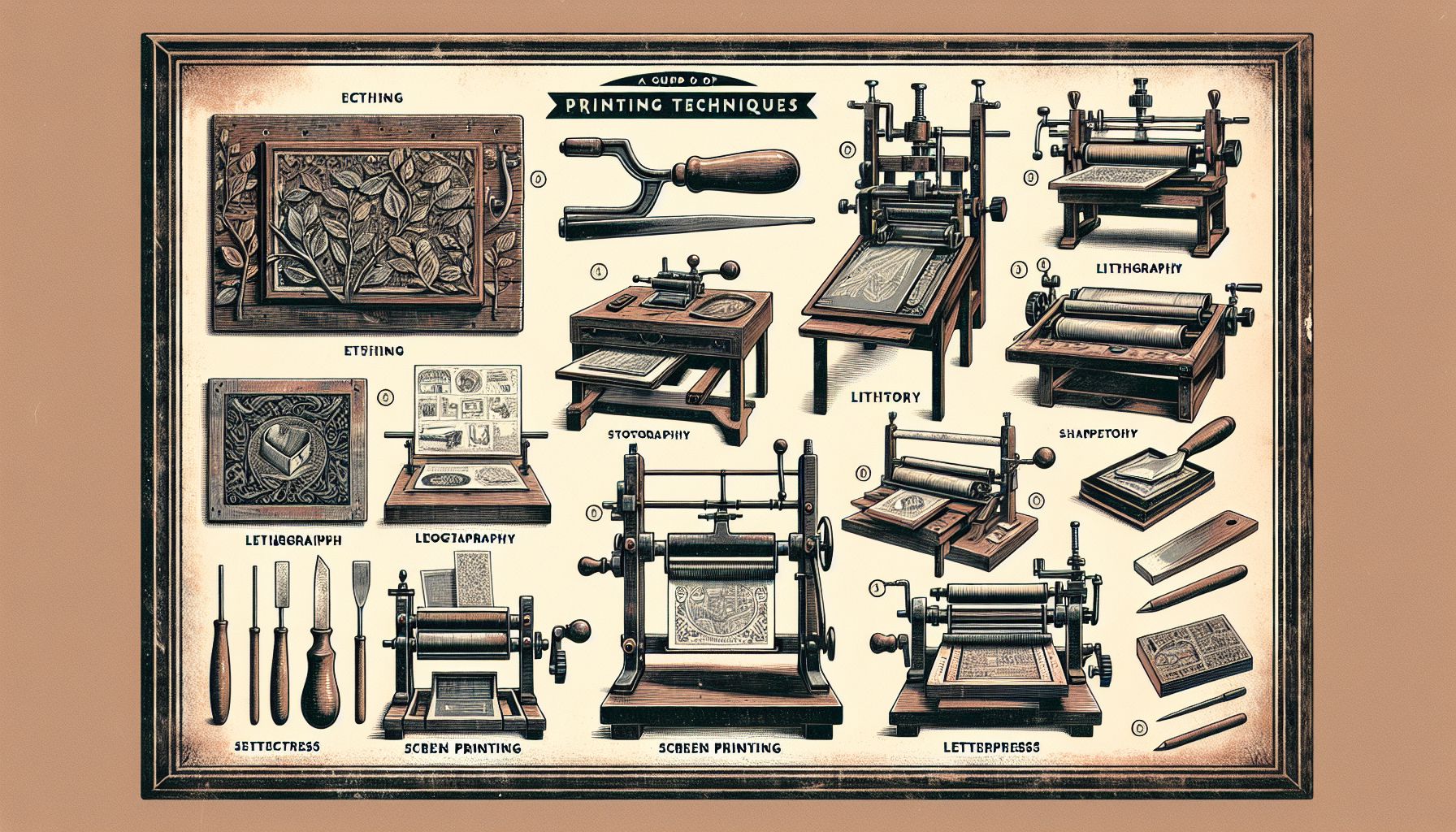
Dive into The World of Printing Techniques – A Comprehensive Guide
Printing is a conventional art form that has transformed dramatically over the years. From the first movable type system by Johannes Gutenberg in 1440 to modern-day digital printing, printing has truly come a long way. In this post, we will explore different types of printing techniques – their process, their applications, and pros and cons – aiming to provide a comprehensive guide that can assist both beginners and seasoned professionals.
1. Offset Lithography
Offset lithography is one of the most commonly used printing techniques in modern times. It functions by transferring ink from a plate onto a rubber blanket, and further onto the printing surface.
Offset Lithography Process
The process starts with creating an image on a plate, usually made from aluminum. This image is then transferred onto a rubber blanket, which in turn transfers the image onto the printing surface. The principle behind this is lithography, where the image area attracts the ink while the non-image area repels it.
Applications of Offset Lithography
Offset lithography is used extensively in large-scale print jobs, including brochures, magazines, stationery, and books. It’s also used for packaging, such as cartons and corrugated boxes.
Pros and Cons
One of the key benefits of offset printing is its high image quality. Furthermore, it offers cost-effectiveness for large volumes, as the cost per unit goes down as the quantity increases. However, short print runs may be expensive due to setup charges. Additionally, making adjustments or corrections after the plate has been made is also complex and time-consuming.
2. Digital Printing
Digital printing has revolutionized the printing industry, allowing the production of higher volumes faster and more cost-effectively than traditional printing techniques.
Digital Printing Process
This process works by translating digital files into printed images using dots of ink. The ink is directly applied to the media, eliminating the need for a printing plate, which saves time and money.
Applications of Digital Printing
Digital printing is commonly used for desktop publishing, variable data printing (such as personalized marketing materials), on-demand printing, and for businesses that want consistency and quality for small print jobs.
Pros and Cons
Digital printing provides an excellent option for small print runs as it has little-to-no setup costs. It also allows for quick turnaround times and customization. However, it may be costly for large volume print jobs compared to offset printing.
3. Flexography
Flexography, often called “flexo,” uses a flexible relief plate for printing.
Flexography Process
The process involves creating an image on a rubber or plastic plate. This plate is inked and directly applied to the material. Flexo presses can be set up to print on nearly any type of substrate.
Applications of Flexography
Flexography is widely used in printing on non-porous substrates required for various types of food packaging. It’s also used for printing on cellophane, paper, plastic, metallic film, and more.
Pros and Cons
Flexo provides high press speeds and is suitable for long runs. It can also be used with a wide range of materials and quick-drying inks. However, setup costs and plate production can be expensive.
4. Screen Printing
Screen printing, also called silk screening or serigraphy, is a technique that uses a woven mesh to support an ink-blocking stencil.
Screen Printing Process
The process involves creating a stencil, which is held in place by a screen. Ink is applied to this screen and forced through onto the printing surface.
Applications of Screen Printing
Screen printing is commonly used for fabrics and textiles, but it’s also used in technology for producing printed circuit boards. It can be used on a variety of materials, such as glass, wood, paper, and plastic.
Pros and Cons
Screen printing allows for high levels of vibrancy, as the ink layer is typically much thicker than other printing techniques. However, it has high initial setup costs, and it’s less suited for intricate, detailed designs.
5. Gravure Printing
Gravure printing, also known as rotogravure or just gravure, is an intaglio printing process that uses a rotating cylinder where the image is engraved.
Gravure Printing Process
The process involves engraving an image onto a copper-plated cylinder. The engraved areas then pick up the ink, while the non-engraved areas are wiped clean before the image is transferred onto the material.
Applications of Gravure Printing
Gravure printing is used for high-quality print work such as brochures, mail order catalogues, magazines, and packaging.
Pros and Cons
Gravure printing can achieve high-quality results fast for extensive runs. But the cost of the copper plate is extremely high and demands high volume runs to be cost-effective.
Conclusion
The world of printing techniques is vast – from the traditional offset lithography to the modern digital printing, and from the high-speed flexography to the detail-oriented gravure printing. Understanding the process, applications, pros and cons of each method can guide you to select the most suitable technique for your specific print job. Happy printing!